Note
Go to the end to download the full example code.
Simultaneous stacking (simstack)
Recover the mean flux of source populations via linear regression on the map.
Simstack (Viero et al. 2013) fits a linear combination of beam-convolved hit maps — one per source population — directly to the map pixel values. Unlike sequential cutout stacking, it simultaneously solves for all populations and therefore removes the cross-contamination between spatially correlated groups.
This example demonstrates simstack() on a synthetic
ContMap with two source populations of known flux.
import astropy.units as u
import matplotlib.pyplot as plt
import numpy as np
from astropy.coordinates import SkyCoord
from astropy.modeling import models
from astropy.nddata import StdDevUncertainty
from astropy.stats.funcs import gaussian_fwhm_to_sigma
from astropy.table import Table
from astropy.wcs import WCS
from photutils.datasets import make_model_image

from nikamap import ContBeam, ContMap

rng = np.random.default_rng(42)
Build a synthetic map with two source populations
Population A — 100 “bright” sources at 1 mJy/beam
Population B — 200 “faint” sources at 0.3 mJy/beam
Both populations are unresolved (beam = 12.5″ FWHM, pixel = 2″).
shape = (128, 128)
pixscale = 2 * u.arcsec
fwhm = 12.5 * u.arcsec
noise_level = 1  # mJy/beam

flux_A = 1  # mJy/beam
flux_B = 0.3  # mJy/beam
nsrc_A = 100
nsrc_B = 200

wcs = WCS(naxis=2)
wcs.wcs.crpix = [shape[1] / 2, shape[0] / 2]
wcs.wcs.cdelt = [-pixscale.to("deg").value, pixscale.to("deg").value]
wcs.wcs.crval = [0.0, 0.0]
wcs.wcs.ctype = ["RA---TAN", "DEC--TAN"]

beam_std_pix = (fwhm / pixscale).decompose().value * gaussian_fwhm_to_sigma


def _make_source_table(nsources, flux, margin=5):
    x = rng.integers(margin, shape[1] - margin, nsources).astype(float)
    y = rng.integers(margin, shape[0] - margin, nsources).astype(float)
    return Table(
        {
            "x_mean": x,
            "y_mean": y,
            "amplitude": np.full(nsources, flux),
            "x_stddev": np.full(nsources, beam_std_pix),
            "y_stddev": np.full(nsources, beam_std_pix),
            "theta": np.zeros(nsources),
        }
    )


table_A = _make_source_table(nsrc_A, flux_A)
table_B = _make_source_table(nsrc_B, flux_B)

map_A = make_model_image(shape, models.Gaussian2D(), table_A,
                         model_shape=shape, x_name="x_mean", y_name="y_mean")
map_B = make_model_image(shape, models.Gaussian2D(), table_B,
                         model_shape=shape, x_name="x_mean", y_name="y_mean")

noise_map = rng.normal(0, noise_level, size=shape)

cm = ContMap(
    map_A + map_B + noise_map,
    uncertainty=StdDevUncertainty(np.full(shape, noise_level)),
    wcs=wcs,
    unit=u.mJy / u.beam,
    beam=ContBeam(major=fwhm, pixscale=pixscale),
)
Convert pixel positions to sky coordinates
coords_A = SkyCoord(wcs.pixel_to_world(table_A["x_mean"], table_A["y_mean"]))
coords_B = SkyCoord(wcs.pixel_to_world(table_B["x_mean"], table_B["y_mean"]))
Single-population simstack
When coords is a single SkyCoord, the
method returns the mean flux and 1-sigma uncertainty of that one population.
flux_fit_A, err_fit_A = cm.simstack(coords_A)
print(
    f"Population A — injected: {flux_A:.1f} mJy/beam  " f"recovered: {flux_fit_A[0]:.2f} ± {err_fit_A[0]:.2f} mJy/beam"
)
Population A — injected: 1.0 mJy/beam recovered: 1.21 ± 0.02 mJy/beam
Multi-population simstack
Passing a list of SkyCoord solves for all
populations simultaneously. Each element of the list defines one
population; the returned arrays have one entry per population.
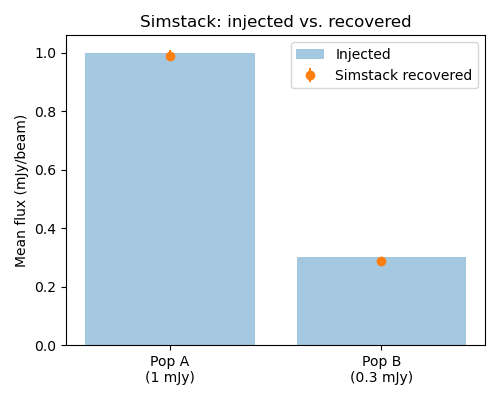
Population A — injected: 1.0 mJy/beam  recovered: 0.99 ± 0.02 mJy/beam
Population B — injected: 0.3 mJy/beam  recovered: 0.29 ± 0.01 mJy/beam
Add a constant offset term
If the map has a residual DC level, pass add_offset=True to absorb it
into the fit. The offset coefficient is appended at the end of the arrays.
fluxes_off, errs_off = cm.simstack([coords_A, coords_B], add_offset=True)
print(f"With offset — Population A: {fluxes_off[0]:.2f} ± {errs_off[0]:.2f} mJy/beam")
print(f"With offset — Population B: {fluxes_off[1]:.2f} ± {errs_off[1]:.2f} mJy/beam")
print(f"Fitted offset             : {fluxes_off[2] * 1e3:.1f} µJy/beam")
With offset — Population A: 0.99 ± 0.02 mJy/beam
With offset — Population B: 0.28 ± 0.01 mJy/beam
Fitted offset             : 5.2 µJy/beam
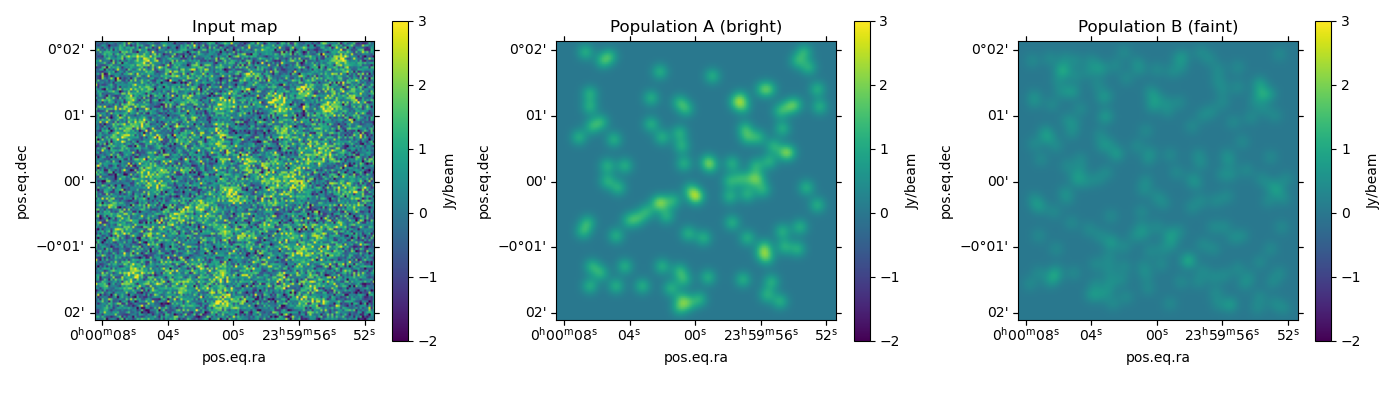
Visualise
fig, axes = plt.subplots(1, 3, figsize=(14, 4),
                          subplot_kw={"projection": cm.wcs})

labels = ["Input map", "Population A (bright)", "Population B (faint)"]
sub_maps = [cm.data, map_A, map_B]
for ax, data, title in zip(axes, sub_maps, labels):
    im = ax.imshow(data, origin="lower", vmin=-2 * noise_level, vmax=3 * noise_level)
    ax.set_title(title)
    plt.colorbar(im, ax=ax, label="Jy/beam")

plt.tight_layout()
Summary plot — recovered vs. injected fluxes
fig, ax = plt.subplots(figsize=(5, 4))
populations = ["Pop A\n(1 mJy)", "Pop B\n(0.3 mJy)"]
injected = np.array([flux_A, flux_B])
recovered = np.array([fluxes[0], fluxes[1]])
errors = np.array([errs[0], errs[1]])

ax.bar(populations, injected, alpha=0.4, label="Injected")
ax.errorbar(populations, recovered, yerr=errors, fmt="o", color="C1",
            label="Simstack recovered", zorder=5)
ax.set_ylabel("Mean flux (mJy/beam)")
ax.set_title("Simstack: injected vs. recovered")
ax.legend()
plt.tight_layout()
Total running time of the script: (0 minutes 0.956 seconds)
